Profile
Conservation's great British triumph. The red kite was virtually extinct in England and Scotland by the twentieth century — today it soars over the Chilterns, the Welsh hills, and beyond.
Red Kite — call
Recording via Xeno-canto — a community of wildlife sound recordists.
The red kite is one of the great success stories of British wildlife conservation. Reduced to a tiny remnant population in mid-Wales, a reintroduction programme beginning in 1989 has seen the species spread across much of England and Scotland. There are now an estimated 1,600–1,800 breeding pairs in the UK — a recovery that stands as a model for raptor conservation worldwide.
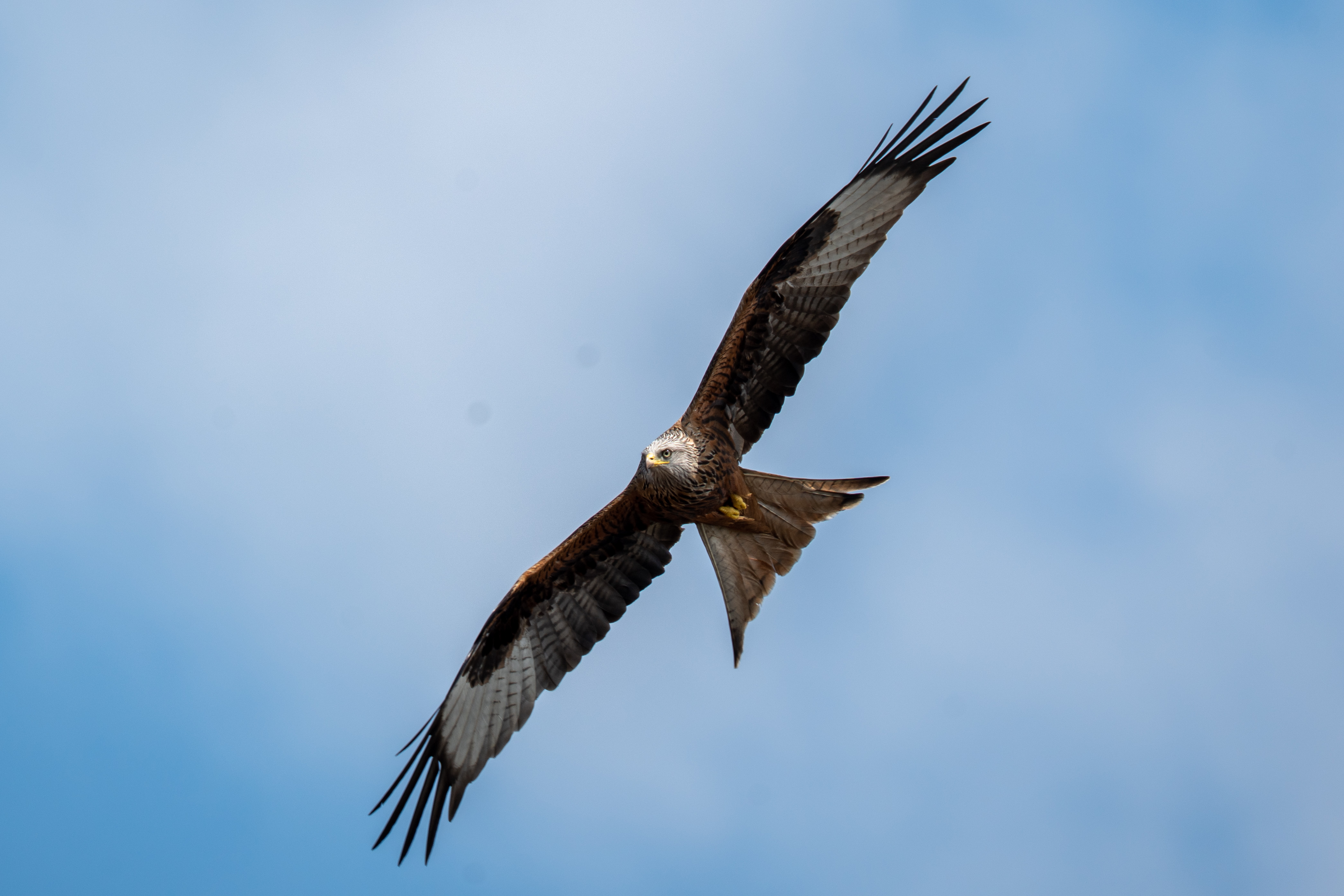
In flight, the red kite is unmistakable — a large, buoyant raptor with a deeply forked rufous tail that acts as a rudder, allowing it to make constant small adjustments in direction as it soars. It is primarily a scavenger, feeding on carrion and earthworms, and has historically shown remarkable boldness around human settlements.
Wingspan
175–195 cm
UK population
~4,000 pairs
Best seen
Year-round, Chilterns
Photography
Identification
Deeply forked rufous tail
The long, deeply forked reddish-brown tail is the red kite's single most distinctive feature — no other large British raptor shares this shape. It is used constantly as a rudder in flight.
White primary patches
Large pale white patches at the base of the primary feathers are conspicuous from below in flight, contrasting with the otherwise rufous and dark brown underwing.
Grey head
The pale grey-white head contrasts with the rufous body and is streaked brown. At close range the yellow cere and dark-tipped yellow bill are visible.
Buoyant, angled flight
The red kite's flight is exceptionally graceful — long wings angled at the carpal joint, body tilting and twisting constantly as the forked tail adjusts direction with minimal wingbeat.
In the field
Vocalisation
The red kite's call is a mewing, slightly wavering whistle — higher-pitched and more plaintive than a buzzard. It is a reasonably vocal bird and calls frequently near the nest and during territorial interactions. The call carries well and is often the first clue to the presence of a bird overhead.
Red Kite — call
Recording via Xeno-canto — a community of wildlife sound recordists.