Profile
Quarrelsome, territorial, and entirely unbothered by your presence — the coot is the bruiser of the British waterway, its white bill-shield a badge of belligerence.
Common Coot — call
Recording via Xeno-canto — a community of wildlife sound recordists.
The coot is one of Britain's most familiar waterbirds, found on almost any lake, reservoir, gravel pit or slow-moving river of reasonable size. It is also one of the most aggressive, conducting furious chases across the water surface with splashing feet and much agitated calling — disputes that can erupt over remarkably trivial provocations.
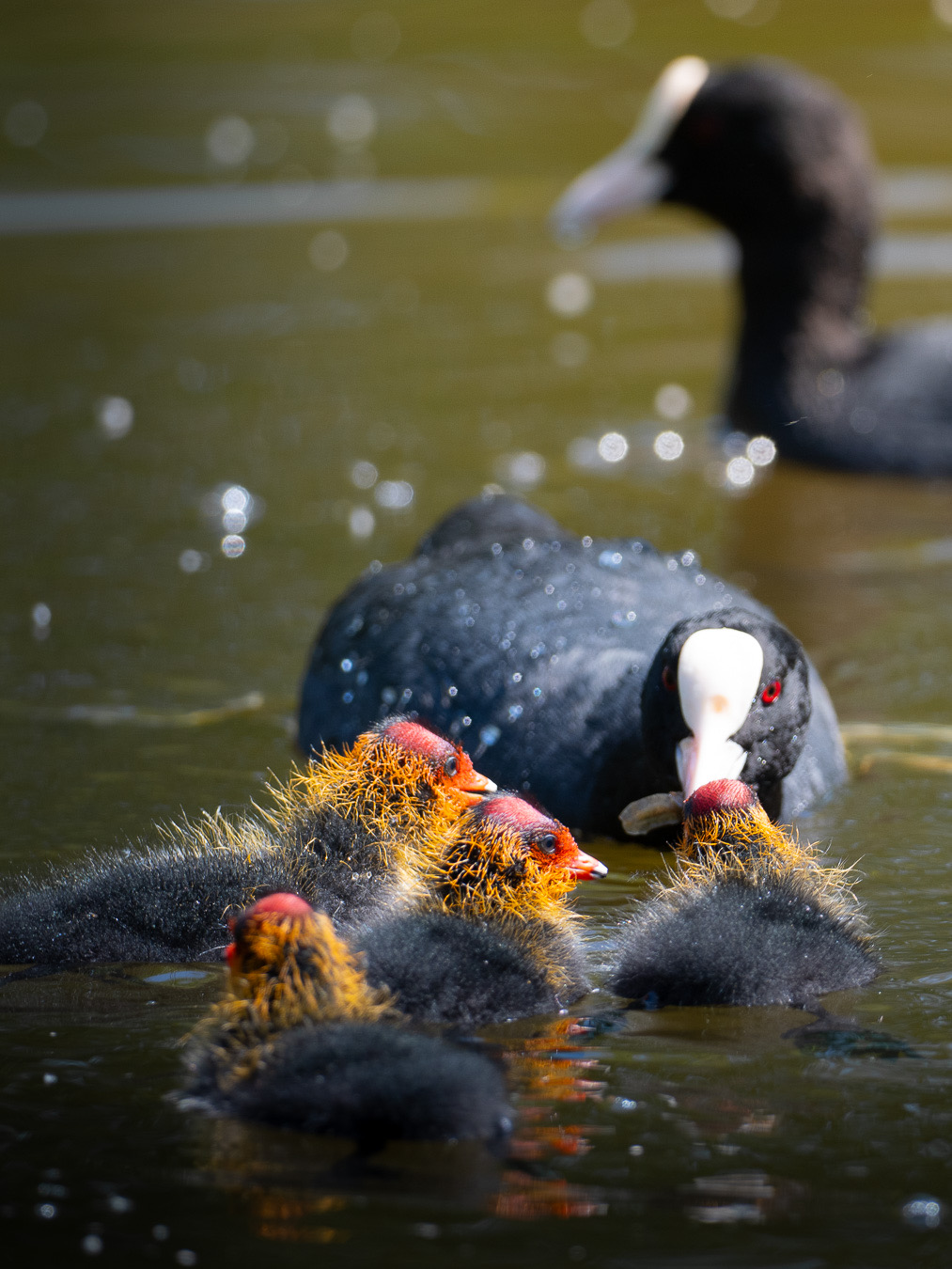
In spring, coots build substantial nests of reeds and water vegetation, anchored to emergent plants at the water's edge. The chicks — extraordinary creatures with bright red-and-orange heads — are among the most distinctive of any British bird. Despite parental devotion during incubation, adult coots are prone to attacking their own young when food is scarce, ruthlessly prioritising the strongest chicks.
Wingspan
70–80 cm
Diving depth
Up to 7 metres
Best seen
Year-round
Photography
Identification
White bill-shield
The distinctive white frontal shield extending from the bill onto the forehead is the coot's most recognisable feature — the origin of the phrase "as bald as a coot".
All-black plumage
Uniform sooty-black body plumage with a slightly paler grey sheen on the flanks. The all-black body contrasts starkly with the white bill and shield.
Lobed feet
Unlike ducks the coot has lobed rather than webbed feet — each toe has separate scalloped lobes that fold back on the forward stroke, visible when the bird walks on land.
White wing stripe in flight
A narrow white trailing edge to the secondaries is visible in flight — a useful feature to separate from the moorhen, which shows white flank patches instead.
In the field
Vocalisation
The coot is a noisy bird with a varied repertoire of sharp, explosive calls. The most common is a loud, abrupt "kowk" or "kik" — delivered with force and frequency during territorial disputes. During breeding season the calls become more complex, with a variety of trumpeting and bubbling notes.
Common Coot — call
Recording via Xeno-canto — a community of wildlife sound recordists.