Profile
The dunnock is the overlooked bird — small, brown, and deliberately unassuming. Look closer, and you will find one of the most behaviourally complex and quietly beautiful birds in Britain.
Dunnock — song
Recording via Xeno-canto — a community of wildlife sound recordists.
The dunnock suffers from a chronic underestimation problem. Its subdued brown-and-grey plumage, shuffling gait and habit of keeping to the base of hedges and shrubs leads most people to dismiss it as a sparrow without a second glance. This is a mistake. The dunnock's song — a bright, warbling phrase delivered from a prominent perch — is one of the sweeter sounds of the garden.
Its social arrangements are among the most complex of any British bird. Dunnocks practise a remarkable variety of mating systems — monogamy, polygyny, polyandry, and polygynandry have all been recorded. The species was the subject of landmark research by Cambridge ornithologist Nick Davies that transformed the understanding of avian reproductive behaviour.
Wingspan
19–21 cm
Weight
19–24 g
Best seen
Year-round, gardens
Photography
Identification
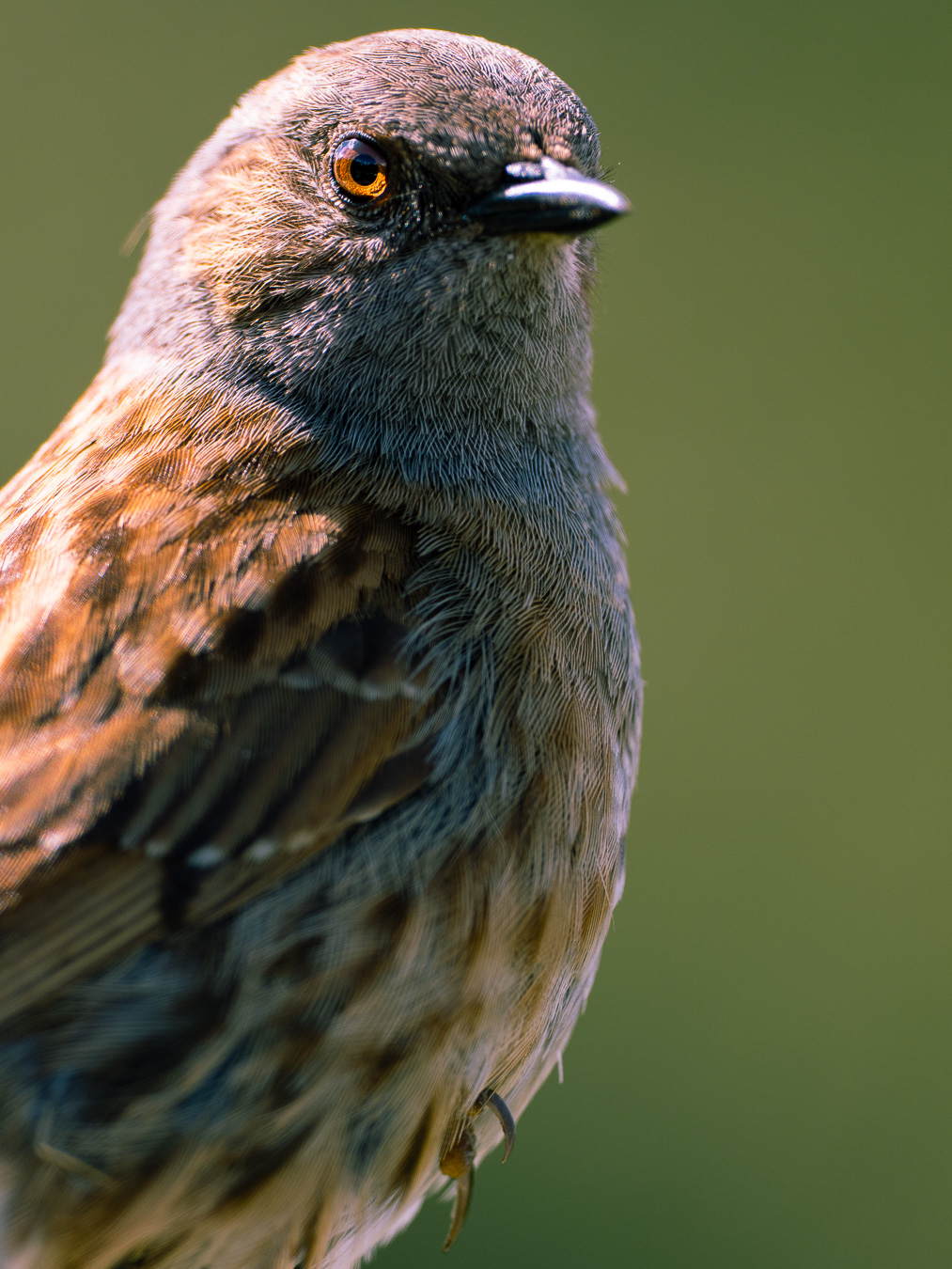
Grey face & breast
The blue-grey face and breast are the dunnock's most distinctive feature, immediately separating it from the house sparrow which has a brown-streaked face.
Streaked brown upperparts
The warm brown, heavily streaked back and wings are sparrow-like but the overall combination with the grey face is distinctive. The streaking is crisp and well-defined in fresh plumage.
Fine pointed bill
The thin, pointed insectivorous bill immediately separates the dunnock from the seed-eating house sparrow, which has a much stouter, triangular bill.
Shuffling, mouse-like gait
The dunnock moves with a characteristic shuffling, low-slung walk, flicking its wings nervously as it forages along the base of hedges and shrubs.
In the field
Vocalisation
The dunnock's song is a pleasant, rather hurried warble — bright and musical, delivered from a prominent exposed perch with a slightly urgent, rattling quality. It is one of the first birds to sing in the new year, often heard on mild January mornings. The call is a sharp, piping "tseep" — thin and high-pitched, easy to overlook.
Dunnock — song
Recording via Xeno-canto — a community of wildlife sound recordists.