Profile
A jewel of fast-flowing water — the grey wagtail's sulphur-yellow underparts and constantly bobbing tail belie its understated name entirely. This is a bird that brings a flash of the exotic to even the most ordinary British stream.
Grey Wagtail — call
Recording via Xeno-canto — a community of wildlife sound recordists.
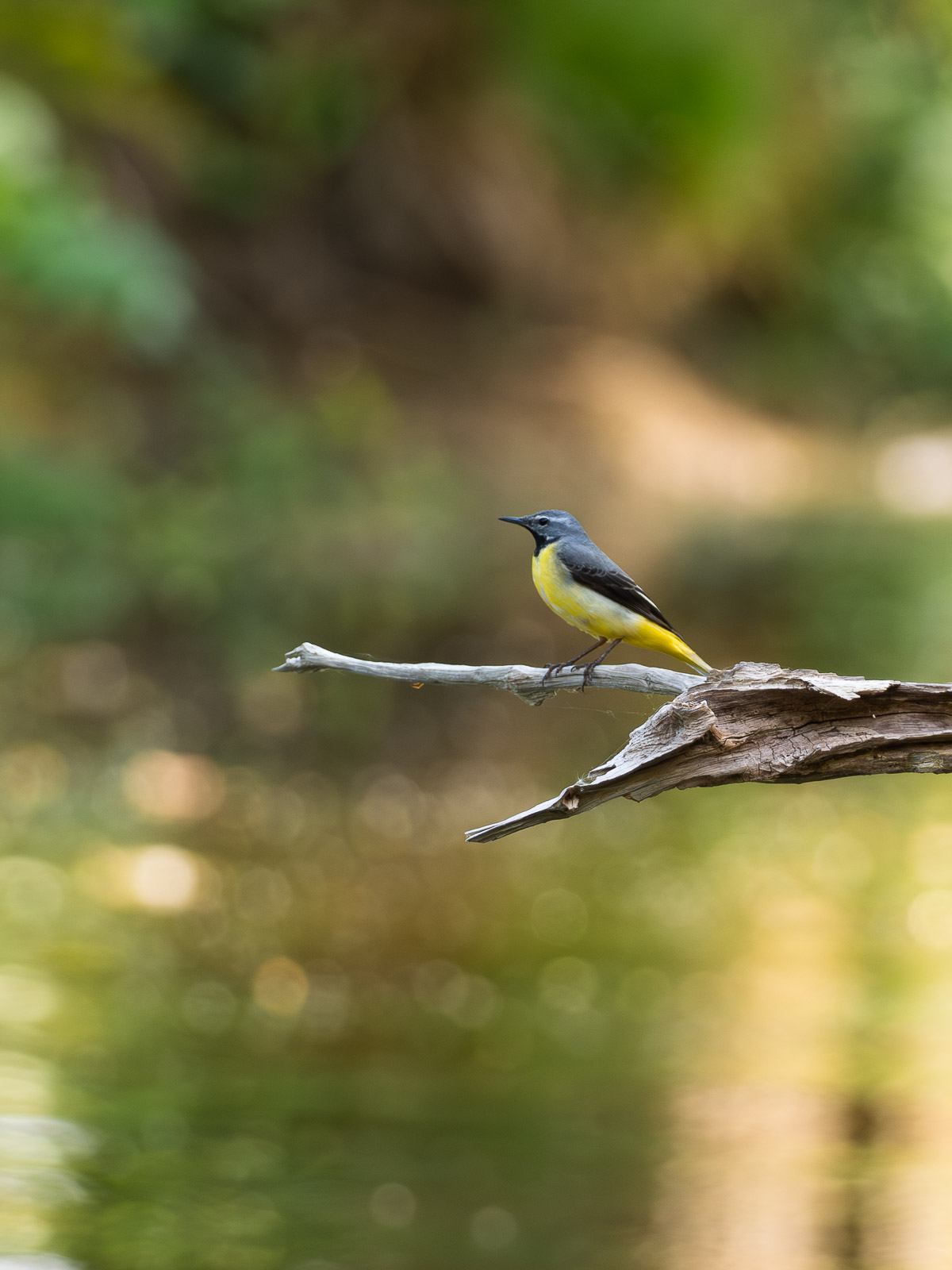
The name grey wagtail is perhaps the most misleading in British ornithology. Yes, the upperparts are grey — but the attention is immediately drawn to the brilliant lemon-yellow underparts, the slate-blue head, and the absurdly long tail that bobs with metronomic persistence. In breeding plumage the male acquires a striking black throat, making him one of the most handsome birds on any British river.
The grey wagtail is closely associated with fast-flowing, rocky rivers and streams, particularly in the uplands of northern and western Britain. It feeds on insects taken from the water surface and surrounding rocks, often running and darting with remarkable agility along boulders at the water's edge. In winter many birds move to lowland rivers, lakes and even urban areas — appearing unexpectedly on car park puddles and flat rooftops far from their breeding streams.
Wingspan
25–27 cm
Tail length
Noticeably longer than body
Best seen
Fast rivers, year-round
Photography
Identification
Sulphur-yellow underparts
The brilliant lemon-yellow underparts — particularly intense on the undertail coverts and vent — are the most striking feature. In the male the yellow extends richly across the breast; the female is slightly paler below.
Black throat (breeding male)
In summer the male develops a striking black bib that contrasts sharply with the grey head and yellow underparts — one of the most elegant breeding plumages of any British bird.
Exceptionally long tail
The tail is disproportionately long — longer than in any other British wagtail — and is wagged up and down almost continuously, giving the bird its characteristic restless, animated quality.
White supercilium
A clear white supercilium runs above the eye, contrasting with the blue-grey crown and dark eye-stripe. A white moustachial stripe is also present in both sexes.
In the field
Vocalisation
The grey wagtail's call is a sharp, metallic "tzit" or "tzi-tzi" — harder and more explosive than the pied wagtail's softer "chissick". It is delivered frequently in flight, often the first indication of the bird's presence as it flies upstream. The song is a simple, rather thin series of high notes delivered from a prominent rock or branch beside the water.
Grey Wagtail — call
Recording via Xeno-canto — a community of wildlife sound recordists.