Profile
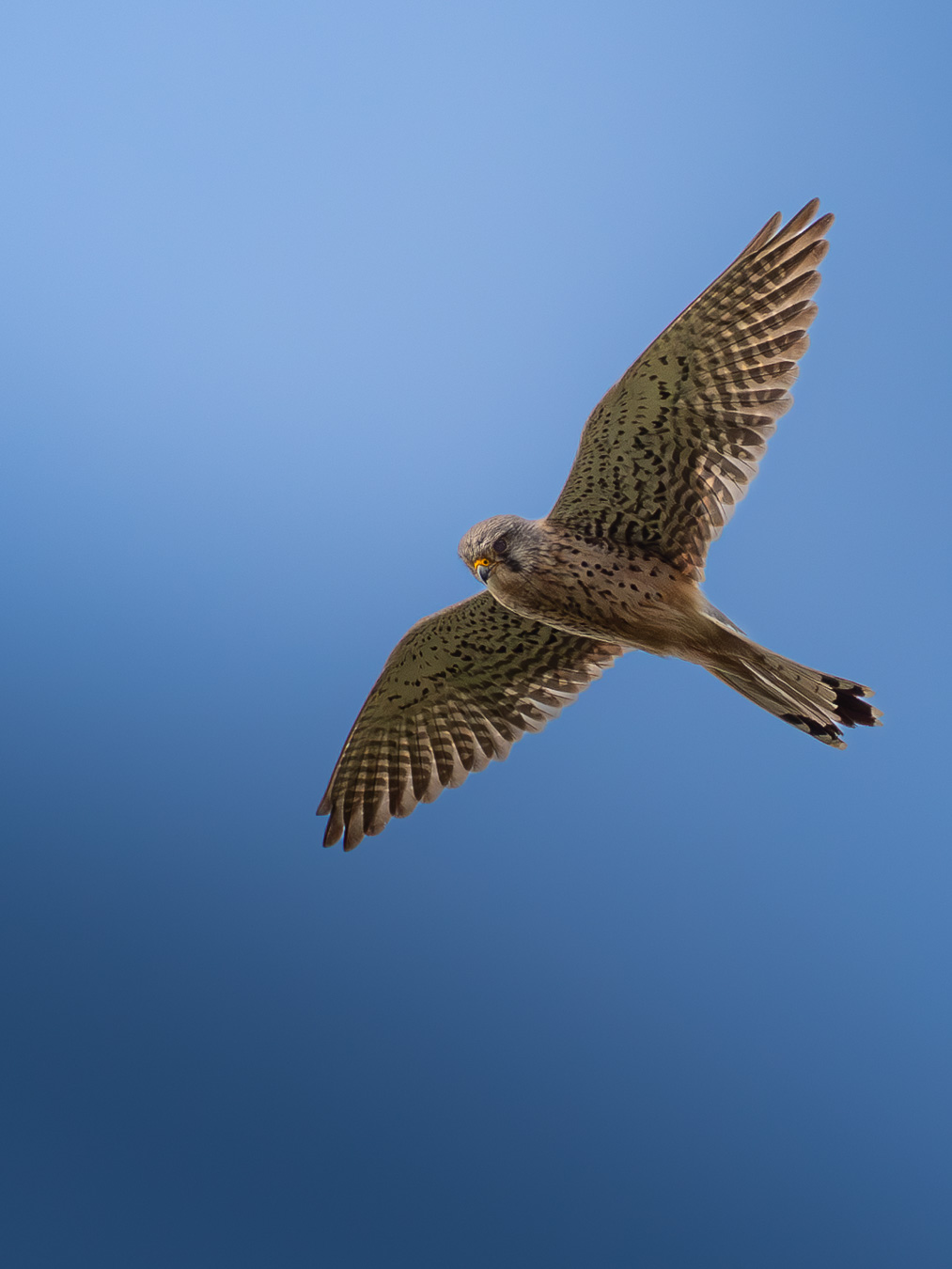
The hovering falcon — suspended against the wind on trembling wings, head locked on a fixed point below with preternatural stillness, before dropping like a stone.
Common Kestrel — call
Recording via Xeno-canto — a community of wildlife sound recordists.
The kestrel was once Britain's most familiar raptor, a constant presence along motorway verges and over rough grassland. Numbers have declined significantly since the 1970s, associated with the loss of rough grassland habitat and the reduction in small mammal prey, but the species remains widespread and its hunting behaviour is as arresting as ever.
The kestrel's ability to hover is made possible by its capacity to hold its head absolutely still relative to the ground, regardless of body movement. It can detect ultraviolet light, allowing it to track the urine trails left by voles across the grass below — invisible to the human eye but luminous to the kestrel.
Wingspan
65–80 cm
Hover duration
Up to 1 minute
Best seen
Year-round, roadsides
Photography
Identification
Chestnut back (male)
The male's warm chestnut-red back and wings, spotted black, contrasts with the blue-grey head and tail. The female and juvenile are warm brown above with heavier streaking throughout.
Blue-grey head & tail (male)
The male's blue-grey head and tail with a single black subterminal band are distinctive in flight. The pointed tail is held slightly fanned when hovering.
Pointed wings in flight
The long, pointed wings are characteristic of a falcon — quite different from the rounded wings of the sparrowhawk. The wing tips are dark, contrasting with the paler underwing.
Hovering behaviour
No other British raptor of this size hovers with such regularity and precision — the absolutely stationary head position while the body adjusts to the wind is unmistakable once seen.
In the field
Vocalisation
The kestrel's call is a rapid, excited "kee-kee-kee" — a shrill, repeated cry most often heard near the nest or during aerial interactions between birds. It is not a particularly vocal species outside the breeding season, and is most often encountered in silence — the hovering form above a roadside bank being the first indication of its presence.
Common Kestrel — call
Recording via Xeno-canto — a community of wildlife sound recordists.